Soccer Referee Simulator 2026
- 4.2
- Rating
- 10.00M
- Installs
- Free
- Price

 Analysis by App-foxy
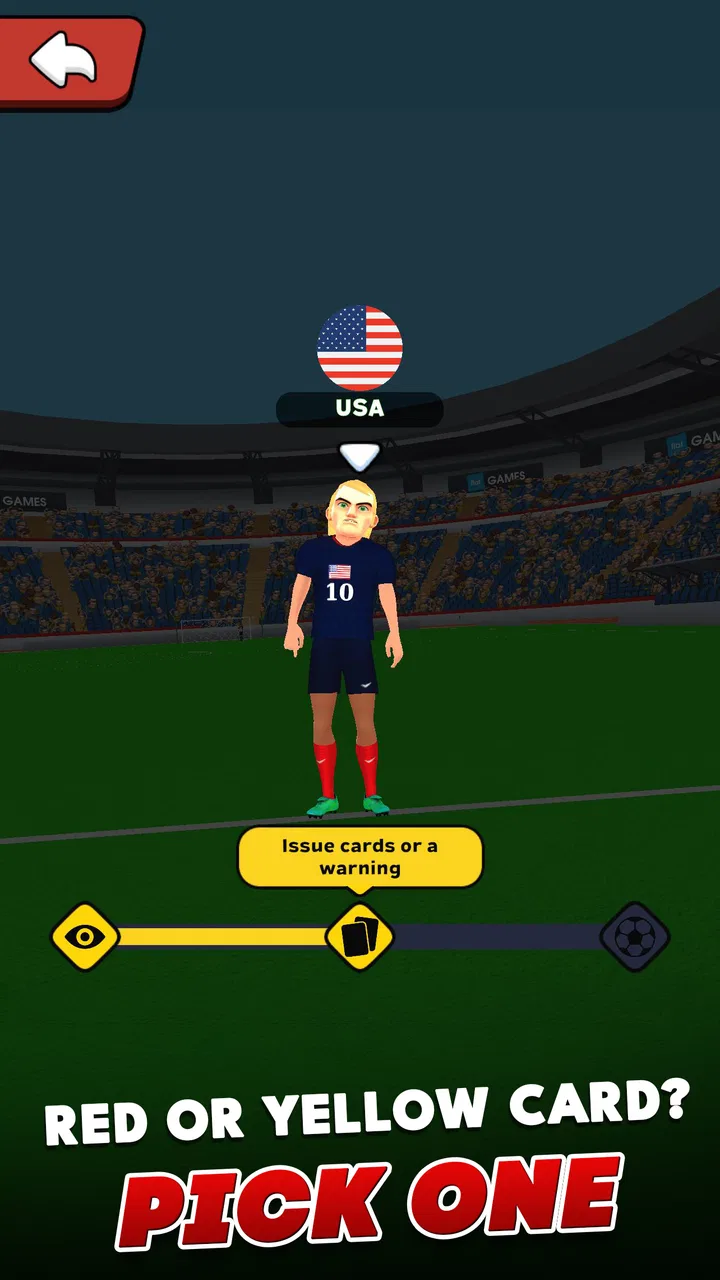
Soccer Referee Simulator 2026 is the kind of sports game I opened expecting a quick novelty and ended up treating more like a concentration exercise. Developed by JLabs Games, it puts me in the referee’s position rather than asking me to score goals, build a club, or control a full team. The central appeal is simple: I have to judge incidents, call penalties, and use video review during World Cup football matches. That change of viewpoint gives the familiar sport a very different mood.
It is a free simulation game for Android, rated Everyone, with a short description that simply calls it “Soccer Referee.” The game has reached over ten million installs and holds an average rating of 4.1 from around ninety-three thousand ratings, which suggests that its straightforward idea has found a sizeable audience. I can understand why. It offers a compact fantasy that many football games ignore: being the person who decides what happens next.
My first impression was not about visual spectacle. It was about responsibility. A striker can miss a chance and try again; a referee has to make a decision and live with its effect on the match. That tension gives ordinary moments more weight. Even a disputed challenge can feel like a small test of attention, especially when I am trying to distinguish a genuine foul from a dramatic reaction.
You May Also Like

 Blood Strike: 2.5 Anniversary
Blood Strike’s Loadouts Turn Every Drop Into a Tactical Gamble
A close look at Blood Strike’s custom loadouts: how fast access to signature weapons reshapes its battle royale rhythm, rewards preparation, and narrows the gap between fights.

 Pandora - Music & Podcasts
Pandora’s Music Is Easy to Start, but Harder to Recover
Pandora’s strength is its low-effort path from a seed to a station. Its weak spot is how much confidence it asks you to place in connection, setup, and quiet recovery.

 8 Ball Pool
 Is Built on Rivalries, Rematches, and Routine
A close look at the rivalries, rematches, shared routines, and unanswered safety questions that turn a quick pool match into a persistent mobile community.

 Samsung Music
’s Quiet Strength Is Playing What You Already Own
Its reach comes less from spectacle than from dependable access to a personal library. That simplicity is both the app’s strongest retention engine and its ceiling.

 AccuWeather: Weather Radar
AccuWeather Review: A Quick, Clear Forecast for Everyday Decisions
For everyday plans, the best forecast is the one you can understand quickly. AccuWeather makes rain timing, radar, and local conditions easy to act on, with a few trade-offs.

 Hill Climb Racing
Why Hill Climb Racing Still Turns Crashes Into One More Run
A tiny car, a bumpy hill and one more upgrade: Hill Climb Racing keeps resurfacing because its simple chaos makes every near-miss feel personal.
More From Our News Desk



How the referee’s world is presented
The art direction works best when it keeps the focus on the pitch and the decisions taking place there. This is not a game I would choose for elaborate club management, detailed player development, or a huge football universe. Its setting is narrower and more practical: I am placed inside the matchday role, watching the action through the eyes of an official.
That narrower setting helps the game establish a coherent identity. The football field is not merely a background for tapping buttons; it is the space where context matters. A challenge near the penalty area feels more significant than one in a harmless part of the pitch, and the promise of VAR gives important incidents a second layer of judgment. The setting therefore supports the mechanics instead of competing with them.
I also like the contrast between the public drama of a World Cup match and the private uncertainty of making a call. The players, crowd, and occasion imply pressure, while the referee’s task demands restraint. Even when the presentation is simplified, that contrast gives the matches a recognizable emotional shape. I am not simply watching football happen; I am interpreting it.
The strongest visual idea is the emphasis on disputed moments. A typical football game rewards quick reactions and attacking creativity. Here, the interesting moment may be the one that makes me pause. I have to inspect what happened, consider whether contact was meaningful, and decide whether the incident deserves intervention. That slower judgment creates a different kind of sports atmosphere.
There is also a useful trade-off in this focused presentation. Because the game is built around officiating, players who want the full texture of a football simulation may find the world limited. I do not get the same sense of club ownership, tactical planning, or personal attachment that a career-focused football game can provide. In exchange, the referee role is much clearer. The game knows what its central fantasy is and generally stays close to it.
A setting built around pressure rather than spectacle
The World Cup framing gives each decision a sense of occasion, even though the basic interaction remains approachable. I found that useful because it makes the referee’s job feel consequential without requiring a complicated rulebook before I can begin. The setting supplies the emotional context; the game asks me to supply the judgment.
That makes it suitable for short sessions with a specific purpose. If I have a few spare minutes and want something more thoughtful than an automatic arcade game, I can step into a match and concentrate on incidents. It is also a good fit for football fans who have argued about refereeing decisions and want to experience how difficult those calls can feel from the other side.
One practical tip is to avoid playing it as if every incident is a reflex test. The setting rewards a measured approach. I get more from the game when I first look at the situation, separate obvious contact from theatrical movement, and use the review option for moments that genuinely justify a closer look. Treating every appeal as proof of a foul removes the interesting uncertainty that makes the simulator work.
Sound, pacing, and the feeling of a live match
The mood of a referee simulation depends heavily on rhythm. Football is not a continuous stream of dramatic events; it alternates between movement, anticipation, interruptions, and restarts. A game about officiating needs that same sense of changing pace. The most satisfying moments are not necessarily the loudest ones. They are the moments when the match seems to hold its breath while I decide.
Sound contributes to that impression by framing decisions as interruptions in the flow of play. A whistle, a reaction, or the transition into a review can make a small incident feel like a meaningful break in the match. I would not describe the audio as the main reason to play, but it supports the role-playing aspect: I am not only selecting an outcome, I am managing the match’s momentum.
The pacing is more deliberate than in a conventional football game. That can be a strength when I want to focus, but it can also expose the game’s repetition. Once the novelty of making calls wears off, I need to enjoy the process of evaluating incidents rather than expecting constant new content. This is a simulation built around judgment, not a highlight reel.
I found the slower rhythm especially useful when playing casually after a busy day. A traditional competitive football game can demand quick movement, precise timing, and constant attention to attacking opportunities. This one gives me a different kind of mental reset. I still need to pay attention, but the attention is directed toward interpretation instead of frantic control.
There is a limit, though. If I am looking for a game that produces immediate excitement every few seconds, I would probably be happier with an arcade football title. The referee role naturally includes quiet stretches, and the game’s atmosphere depends on accepting those pauses. Its pacing is coherent, but it is not universally entertaining.
Why the rhythm matters to the mechanics
The match atmosphere works because the game’s main tools are tied to moments of uncertainty. Calling a penalty is not just another action in a menu; it changes the emotional direction of the match. VAR adds a deliberate pause, allowing me to reconsider rather than forcing every decision to be instant. That pause is important because it turns review into part of the drama instead of a decorative option.
I recommend using the review process as a judgment tool rather than a safety net. If I rely on it automatically, decisions lose their character and the match becomes a sequence of confirmations. If I reserve it for ambiguous incidents, it creates a better balance between confidence and caution. This is one of the more interesting ways to make the game feel less mechanical during longer sessions.
The sound and pacing also make it easier to understand who should skip this game. Players who want deep tactical control, realistic team progression, or a large collection of football modes may find the referee perspective too narrow. Someone who enjoys analyzing controversial calls, however, may appreciate that the game creates tension from situations that other football games treat as background details.
Where the mechanics fit—and where they do not
As a simulation game, Soccer Referee Simulator 2026 succeeds when it turns simple actions into decisions. The controls do not need to resemble a full football game because I am not dribbling, passing, or defending. The important interaction is deciding how to interpret an incident and whether the match should continue, stop, or move toward a penalty decision.
That makes the game easy to approach. A newcomer does not need to master a squad of players or learn an extensive control scheme before understanding the objective. I can begin with the basic idea immediately: watch the situation, assess the decision, and use VAR when the moment calls for closer examination.
The simplicity is also the main mechanical risk. A referee simulator can become repetitive if the situations do not feel meaningfully different or if the correct response becomes too predictable. I noticed that the game’s long-term appeal depends less on unlocking a complicated system and more on whether I enjoy making these calls repeatedly. It is a focused loop, and focused loops need strong variation to remain fresh.
For that reason, I see it as better for short, repeatable sessions than as a replacement for a full football game. I might play it while waiting for an appointment, during a commute, or when I want a sports-themed game that does not require a long commitment. I would not choose it for a full evening if my goal were a broad career mode or a detailed simulation of club football.
The free entry point makes experimenting easy, although in-app purchases range from forty-nine cents to sixteen dollars and ninety-nine cents per item. I would approach those purchases carefully and first decide whether the core decision-making loop holds my interest. The game is most appealing when I enjoy the role itself, not when I am trying to buy my way past the parts that require patience.
Because the game is free and supports Android devices running version 7.0 or later, it is accessible to people using a wide range of phones and tablets. The current version is 1.1.136, so anyone installing it should make sure the app is updated through the normal store process before judging the experience. I would also keep expectations realistic: broad compatibility does not turn this focused referee game into a technically elaborate console-style football simulation.
Practical ways to get more from each match
My first recommendation is to create a personal decision routine. Before choosing a call, I look at three things: where the incident happened, whether the contact affected the play, and whether the situation is clear enough to justify immediate action. This gives the match structure and stops me from making decisions based only on the most dramatic animation or reaction.
My second tip is to treat penalties as moments of match management rather than isolated rewards or punishments. A penalty changes the tone of the game, so I try not to let the importance of the outcome influence the evidence I am considering. That mental separation is a small detail, but it is what makes the referee role more interesting than simply selecting the most severe option.
My third tip is to use the game as a conversation starter with another football fan. Handing the phone to a friend after a controversial incident creates a simple challenge: would they make the same call? This works particularly well because the game’s appeal is based on interpretation. It does not need a complicated multiplayer structure to create discussion; the decisions themselves provide the disagreement.
A fourth useful approach is to play it when I want a change from conventional sports controls. If I have spent time with football games where I control the winning team, switching to the referee perspective exposes how much drama comes from stoppages and judgment. It is not a direct substitute for those games, but it complements them by focusing on the part of football that players usually complain about from the sidelines.
Who should play it, and who should choose something else?
I would recommend this game to football supporters who enjoy the rules as much as the goals. It is also a good choice for casual players who want a simulation with an immediately understandable premise, and for anyone curious about why refereeing decisions can be difficult even when they look obvious on a replay.
It is less suitable for players who need constant action, detailed character progression, or a large set of strategic systems. If my ideal football game involves building a team, arranging formations, negotiating transfers, and playing complete matches from multiple positions, I would choose a management or traditional football title instead. Those alternatives offer more variety in how I influence the result.
I would also skip it if I dislike revisiting similar decisions. The referee perspective is the whole point, and the game does not need to pretend otherwise. Its strength is concentration around calls, penalties, and VAR. Its weakness is that this same focus can feel narrow once I have exhausted the initial curiosity.
The Everyone age rating makes it a comfortable recommendation for a broad audience, but that does not mean every player will find it equally engaging. Younger players may enjoy the clear football theme and simple premise, while experienced football fans may be more sensitive to whether the judgments feel convincing. The best audience is not defined only by age; it is defined by patience for observation and interest in match decisions.
One question I had before spending much time with it was whether I needed to understand every football rule. I did not find the premise difficult to grasp. The game communicates its central task through the situations themselves, and a player can learn by paying attention to the consequences of each call. Still, someone who already knows the difference between a minor challenge and a serious foul will probably get more satisfaction from the decisions.
Another practical question is whether it can replace watching real football. For me, it cannot, and it should not try. A real match has unpredictable tactics, personalities, momentum, and stakes that a compact mobile simulation cannot reproduce. What this game offers is a small interactive version of one responsibility inside that larger spectacle. I enjoy it most as a companion to football interest, not as a complete substitute for the sport.
The developer, JLabs Games, has chosen a clear niche rather than hiding the referee concept inside a broader football package. That clarity is valuable. I always know why I am playing, and the game’s presentation, sound, and rhythm generally support that purpose. The experience is more convincing when I accept its scale and judge it as a focused officiating game rather than a complete football universe.
My atmosphere verdict
What stays with me is the game’s particular mood: a match is moving quickly, an incident interrupts it, and I have to decide whether the interruption matters. The art direction keeps attention on the field and the official’s viewpoint. The sound and pauses give decisions room to breathe. The mechanics then turn that atmosphere into a playable responsibility through penalties and VAR.
That combination is more effective than the short store description might suggest. The game is not built around scoring goals, collecting a huge roster, or creating a long managerial career. It is built around the uncomfortable space between certainty and doubt. When I play patiently, that space creates genuine tension.
Its limitations are clear. The focused loop can become repetitive, the referee perspective will not satisfy players looking for a complete football simulation, and in-app purchases mean I would take a careful look before spending beyond the free experience. Those are meaningful considerations, not minor complaints.
Even so, I think Soccer Referee Simulator 2026 is worth trying if the idea of controlling the match from the official’s side sounds appealing. It is free, accessible on older Android versions, and easy to understand without sacrificing the central question of every incident: what really happened, and what should happen next?
My recommendation is simple: install it for the decision-making, not for a full football career. If you enjoy reviewing controversial moments, comparing calls with friends, and playing a sports game at a calmer pace, this focused simulation has a distinct personality. If you want nonstop action or deep team management, another football game will serve you better.
FAQs for Soccer Referee Simulator 2026
01What is Soccer Referee Simulator 2026 and how does it work?
Soccer Referee Simulator 2026 is an engaging simulation game that allows players to experience the life of a soccer referee. Players make real-time decisions on fouls, offsides, and penalties during matches. The game offers realistic graphics and scenarios, providing a comprehensive understanding of a referee’s challenges and responsibilities in professional soccer.
02Is Soccer Referee Simulator 2026 available for both Android and iOS devices?
Yes, Soccer Referee Simulator 2026 is available for download on both Android and iOS platforms. You can find it on the Google Play Store for Android devices and the Apple App Store for iOS devices. Ensure your device meets the minimum system requirements for optimal performance.
03What are the key features of Soccer Referee Simulator 2026?
The game features realistic match scenarios, advanced AI opponents, and a detailed referee career mode. Players can make critical calls, manage game pressures, and improve their skills through various levels. It also includes a comprehensive tutorial to help new players understand the rules and mechanics of soccer refereeing.
04Does Soccer Referee Simulator 2026 require an internet connection to play?
Soccer Referee Simulator 2026 can be played offline, allowing users to enjoy the game without an internet connection. However, some features, such as leaderboards and updates, may require internet access. It’s recommended to connect occasionally to ensure you have the latest content and improvements.
05Are there in-app purchases or advertisements in Soccer Referee Simulator 2026?
Yes, the game includes optional in-app purchases that provide additional content and enhancements such as new uniforms or advanced referee tools. Advertisements may appear between matches, but players can opt to purchase an ad-free version for a more uninterrupted experience. Always check the in-app purchase options to manage spending.
Pros
- Realistic match scenarios enhance immersion.
- Intuitive controls for smooth gameplay.
- Wide variety of leagues and tournaments.
- Regular updates with new features.
- Detailed statistics for performance tracking.
Cons
- Occasional bugs disrupt gameplay.
- Limited customization options for avatars.
- Requires constant internet connection.
- Tutorials could be more comprehensive.
- High battery consumption during play.

Soccer Referee Simulator 2026
Gallery